
‘Shandon’, is my 24th local history publication since 2005, and examines the history of the ‘RACKS’ area situated in Knock townland (Gaelic: ‘an cnoc’, the hill), East Belfast. RACKS is an acronym that stands for ‘Residents’ Association of Cherryvalley, Kensington and Shandon’. The history of the RACKS area (although the RACKS organisation was formed in 2007) dates mostly to the Victorian and Edwardian period although there are links to Norman times during the 12th century.
Shandon Park is a very pleasant residential suburb of East Belfast, perhaps best-known today for Shandon Park Golf Club. Knock townland is about 288 acres in area. Griffith’s Valuation of Tenements for Co Down was completed in 1864 and shows that c.92% of the leases at Knock were owned by Thomas McClure, who lived in a large house known as ‘Belmont’, now the location of Campbell College.

The name of ‘Shandon’ is an old Anglicized Gaelic name originally ‘Sean dun’, meaning old fort. Known locally as the Shandon Mound (above) this earthwork is probably a motte, located on high ground with good views, dating to Norman times during the 12th century. It is situated not far from the old Knock Church (said to have been visited by St Columba) and graveyard.
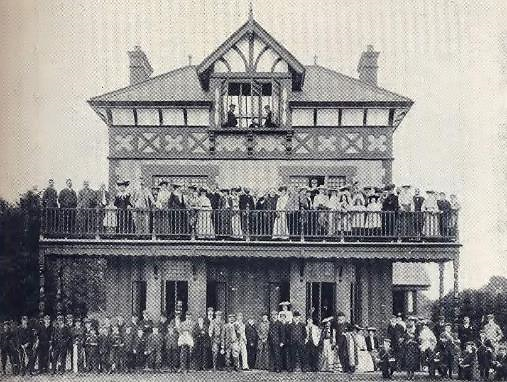
A substantial clubhouse (above) for Knock Golf Club at Shandon Park was constructed and opened by the Lord Mayor of Belfast, Sir Otto Jaffe J.P., on Saturday 18th June 1904. It was the last word in Edwardian grandeur and described in the press as: ‘The finest of its kind in the city….an exceedingly handsome and compact structure…that leaves nothing to be desired. The building is of early English architecture and has been built with best Annadale facing brick, the windows and doors having red Dumfries stone dressings (with) a handsome veranda and granolithic terrace’. It became a private residence called ‘Ben-Hur’ following the departure of Knock G.C. to Summerfield in the 1920s and was demolished in 2017 for the Shandon Park Lane development.

Knock Hockey Club was based at Shandon Park in 1930. The club folded in 1936 and ‘three of their best players’ including Davvie Camlin (centre, front), one of the family that operated Camlin’s Nursery at nearby Kensington Gardens, joined the newly formed Northern Ireland Civil Service club at Stormont. Davvie’s brother Jack is standing 2nd left. Civil Service had recently abolished their ‘civil servants only’ ruling and the three Knock players were their first recruits. The house in the background is Rialto at 33 Kensington Road and the photograph was taken from the site of what became 135 Shandon Park (which was demolished in 2014).

A side view of Kensington House, 12 Kensington Road, shortly before demolition in the 1980s for the construction of the Kensington Court and Kensington Gate developments on the substantial gardens and orchard facing Marie Curie Hospice. This was probably the first house built on Kensington Road and was originally set in over four acres of grounds. It was the home of leading East Belfast retailer Charles. E. Bourke (inset) from the 1920s-1960s. He established his department store on Newtownards Road in the 1890s and once employed 100 members of staff. C.E. Bourke was once a Belfast City Councillor and generous benefactor of the Methodist Church.

In 1915 Ernest Camlin enlisted in the Royal Irish Rifles, and following wounds spent some time at the UVF Hospital (now Somme Nursing Home), Circular Road, Sydenham. He was honourably discharged on 4th March 1919. Ernest came from a family of garden nurserymen based at Larkfield Road, Sydenham and by the 1920s (above) had embarked on his own venture at Kensington Gardens. The large house in the background is today located at 4-8 Kensington Gardens and the house to the right is 2 Kensington Gardens, all built during the First World War.

New houses were built by Belfast Corporation at Cherryvalley, and at a number of locations around the city in the 1920s including Woodvale, Wansdworth, and Whitewell. This is an early view of 39-43 Cherryvalley Park. The Belfast Book, 1929 notes: ‘Even a superficial examination is sufficient to show how immensely superior the houses are to the parlour and kitchen houses of pre-First World War times. Due regard has been paid to the provision of ample private open space in the form of gardens. There has been a complete breakaway from the pre-war ideas of building narrow fronted houses, close up to the footpaths, and in long unbroken rows.’

On a sunny day in the summer of 2022 Christine and I visited the wonderful Plantation era Antrim Castle Gardens with our friends Lillian and Adrian Ross. An absolutely super destination for a day out. I noticed this sign (above) in the flowerbed: ‘Beware of the Agapanthus – if attacked, back away slowly’. I thought of my conversation with Mrs Symes who was resident at 106 Kensington Road many years ago. We had talked about another big house on Kensington Road called ‘Lanaven’, now the site of the Kimscourt apartment block. So, what is the connection?
 eastbelfasthistory.com