
This spoken and illustrated history is entitled East Belfast – Another Look.
This book takes another look at the everyday lives and reminiscences of the working people of East Belfast plus various significant moments as captured by newspapers and photographs. Some readers may recall the coalman, blacksmith and milkman, the Belfast & County Down Railway, the construction of the Ulster Hospital, the three-wheeler Short’s built Nobel 200 car, the bombing of the Oval during the 1941 Blitz, the Big Freeze of 1963, the collapse of St Brendan’s Church plus many more memories.

Brothers Hugh (left) and Thomas McCullough are hard at work on the re-construction of St. Brendan’s Church of Ireland at Larkfield Road which had collapsed during a storm. They were part of a volunteer contingent of retired shipyard workers, who it was reported, spent 25-30 hours per week ‘on the job’ putting their ‘wealth of talent’ to good use. During their tea break they would talk about old times in ‘The Yard’. All the mild steel and equipment such as anvils and tools were provided by John Eastwood and Sons, whilst the British Oxygen Company supplied an oxy-acetylene cutter. St Brendan’s was re-consecrated in October 1967 and during the sermon Bishop Alan Buchanan remarked that ‘In 1963 your church stood after many years of waiting. Then it was almost razed to the ground. Now it has risen again’.
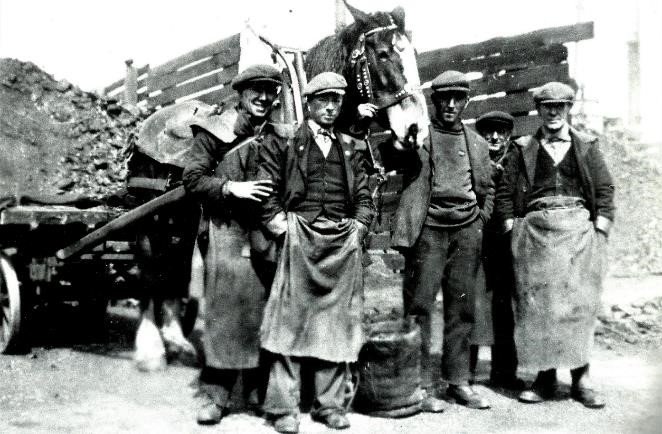
Fred Curragh, far left, with his workmates in 1946, was employed by ‘John Kelly Ltd, Coal Merchants and Steamship Owners’ who had premises at Station Street and Scrabo Street, Queen’s Quay, not far from the Belfast & County Down Railway headquarters. Once upon a time coal made the world go around. Until modern times it was the primary form of energy used to heat homes and provided power for factories, ships and steam locomotives.

Robert Dowling (right) was appointed Assistant Cashier in 1910 at the Belfast & County Down Railway (BCDR) headquarters, Queen’s Quay. It is now the site of the Odyssey entertainment complex. Here he is hard at work, in the 1930s, making up the weekly payroll (in cash) with Chief Cashier Mr. Evans. Part of Robert’s job was to take a journey around the 49 stations and halts on the BCDR rail network, along with wife Lottie and daughter Rosemary, to hand out the pay packets.
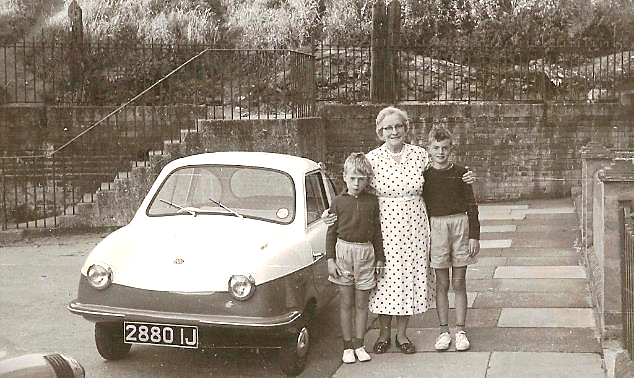
Minnie Gray is outside her home at 37 Moorfield Street with grandsons Eric and Mike in the late 1950s. The wall in the background is the embankment of the Belfast & County Down Railway. The small car is a Nobel 200 owned by son Jack Gray. It had a 200cc motorcycle engine (one is on display at Ulster Folk & Transport Museum, Cultra) and a fibre-glass body and was constructed locally under licence by Shorts Aircraft, first at their Newtownards site and then Queen’s Island site. One of the key figures in bringing the project here in the 1950s was Cyril Lord, well-known as a carpet manufacturer. Unusually the Nobel had no reverse gear and required engine reversing.

On the left is blacksmith’s assistant Abie who is holding a very young Laura Dickson in his arms outside the forge at 281 Upper Newtownards Road in the 1930s. Laura is the smallest of the three girls in the later photograph, right. The man holding the horse’s tail is blacksmith Edward (Ned) McNally and the man shoeing the horse is Abie. Belfast Street Directories record Ned McNally at this address from 1907 until the 1950s. As well as shoeing horses the smithy also carried out decorative ironwork. Apparently before World War Two they made iron railings for Dundonald Cemetery and for Belfast City Hall which were later collected as scrap metal for the ‘War Effort’.

Billy McCrea lived at Sandown Road near Ballyhackamore and delivered buttermilk to houses in East Belfast for many years. Here is a smiling Billy with his fine horse (Jimmy) and cart with churns (milk was not delivered by bottle or carton in those days) at Clonlee Drive in June 1932. The tall house in the distance is situated at 194 Upper Newtownards Road.
 eastbelfasthistory.com