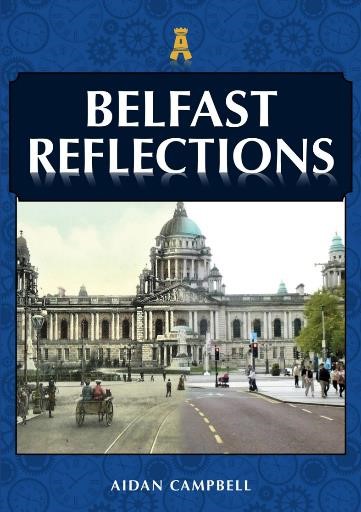
Belfast is the capital city of Northern Ireland and has been a major port and industrial city since the nineteenth century. Ship building has long been an important industry in the city and the Titanic Quarter, named after its most famous ship, is one of the largest waterfront developments in Europe. In the last two decades the city has become transformed, attracting large numbers of visitors to its cultural heritage. Large areas of the city have been redeveloped but much would also be recognisable to previous generations.
Belfast Reflections is an exciting collection of historic and modern pictures that are individually merged to reveal how the area has changed over the decades. Each of the 180 pictures in this book combines a split-image effect, readers can see how streets, buildings and everyday life have transformed with the passing of time.

A great view of Belfast City Hall from Donegall Place. It was modelled on St Paul’s Cathedral by architect Brumwell Thomas, constructed by H. & J. Martin over the period 1896-1906 and described as ‘an exuberant Edwardian wedding-cake of a city hall in Portland stone’. The central copper is 173 feet in height. Officially opened on 1st August 1906 it is located in Donegall Square, a site previously occupied by the White Linen Hall since 1784. Belfast was awarded ‘City’ status in 1888 and the grand City Hall replaced the smaller Belfast Town Hall in Victoria Street. A local newspaper article in 1906 described Belfast City Hall as ‘a monument to the character of the people of Belfast’ and a later writer as the ‘beating heart of Ulster’s metropolis’
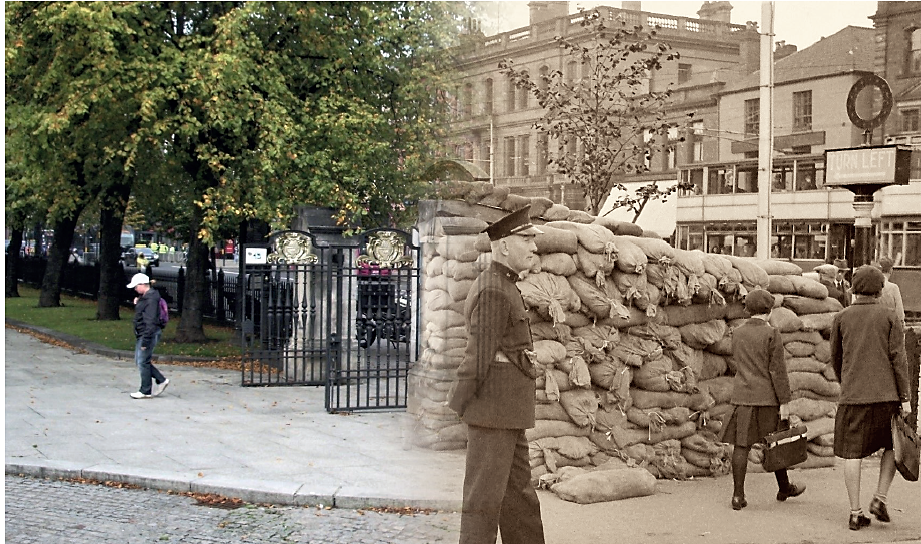
A lone R.U.C. (Royal Ulster Constabulary) constable is on duty at the front gates of Belfast City Hall (Donegall Square North) on 4th September 1938 and the caption helpfully describes ‘Building air raid shelters during the crisis’. The crisis was the build-up of hostilities in Europe by Germany who had annexed Austria (The Anschluss) in March 1938 and preparations were underway in Belfast during the prelude to the Second World War. An interesting local press report in August 1939 by Sir Kingsley Wood, Secretary of State for Air, during a visit to Belfast quoted him as saying that he thought ‘war was not inevitable’.
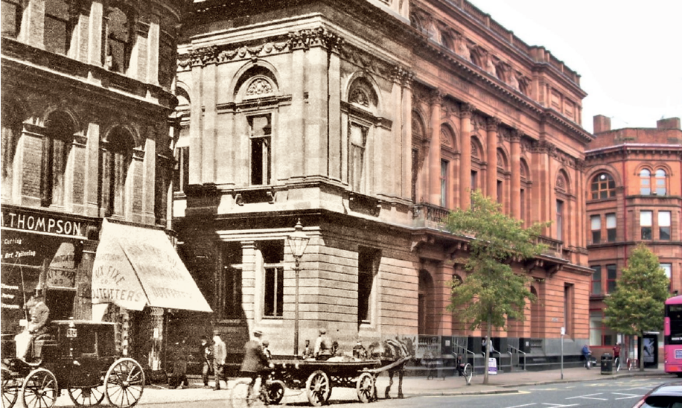
The impressive Belfast Free Library, now known as Belfast Central Library, was constructed by H & J Martin from Dumfries red sandstone. Unfortunately, a consignment of sandstone on its way from Scotland was lost at sea during construction. It was originally known as a ‘free’ library for all readers and operated by Belfast Corporation as opposed to a subscription-based library frequented by the upper and middle classes. Notably, the library was officially opened by the Marquis of Londonderry, on 13th October 1888, who on the very same day attended a banquet in the old White Linen Hall and conferred ‘City’ status on the town of Belfast. In more recent times Belfast Central Library doubled as police headquarters in the BBC drama ‘Line of Duty’.

The name of Shaftesbury Square was first recorded in 1887. It is a major road junction and meeting place of Great Victoria Street, Dublin Road, Donegall Pass, Botanic Avenue, Bradbury Place and Donegall Road. It is named after the 8th Earl of Shaftesbury, who in 1857 married Harriet Chichester the only daughter of the 3d Marquis of Donegall. The route from Great Victoria Street to University Road has been dubbed the ‘Golden Mile’ and is well-known today for hotels, hospitality venues and eateries. However, in Victorian times there were many residents from the medical profession, plus at least one hospital and may have been accurately referred to as ‘the valley of the shadow of death’. In the 1910 view the building in the centre is the Magdalene Parochial Hall of St. Mary Magdalene, Church of Ireland in neighbouring Donegall Pass. It was opened in 1853 as a ‘Sunday & Day School’ but closed and demolished as traffic volumes increased. The site had been occupied by a large bank building since 1960 but it recently closed.
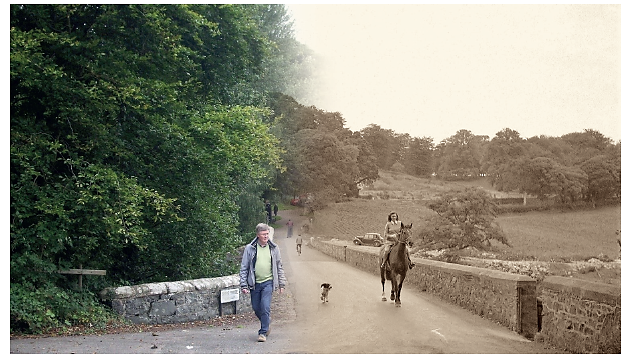
Back in the late 1600s, Shaw’s Bridge was one of the very few crossing points over the River Lagan between the Long Bridge in east Belfast and Lisburn. The picturesque stone bridge in this 1940s scene was constructed in 1709 to replace an earlier wooden bridge built by a Captain Shaw in 1655 to facilitate Oliver Cromwell’s artillery. It was in use as a road bridge until 1977 when the new wider A55 bridge was completed to relieve traffic congestion on this busy thoroughfare. The old bridge has been thoughtfully preserved in the 4,000-acre Lagan Valley Regional Park which includes such varied historical features as elements of the now defunct Lagan Navigation canal (1763), locks and towpath, the Neolithic ‘Giant’s Ring’ which pre-dates the Egyptian pyramids and the more modern Mary Peters Athletic Track.
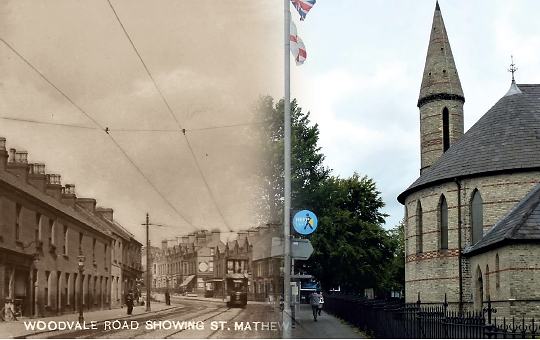
St Patrick is said to have passed this way in 455 A.D. on his travels, probably following the route of the neighbouring River Farset. St Matthew’s Church of Ireland is the parish church of Shankill, Gaelic: Seanchill, ‘Old church’ and situated where Shankill Road meets Woodvale Road on the corner of Cambrai Street. The church building was described as ‘a wholly astonishing church’, when consecrated in 1872. Its style has been described as ‘Byzantine’ and in addition to the Irish round tower the building contains four Corinthian columns to support the roof. It replaced the ‘Old St Matthew’s Church’ which was built in 1839 on the site of the existing Parochial Hall, beside Shankill Graveyard and alongside the River Farset. In those days there was only one house on Shankill Road between St Matthew’s and Peter’s Hill. The Campbell family all attended St Matthew’s during the 1960s when my father Rev. Canon A.J.E. Campbell was Rector here.
 eastbelfasthistory.com